An overbite — a Class II malocclusion — is a bite in which the upper jaw sits forward of the lower one, or the lower jaw has not grown far enough forward. It is the most common bite discrepancy seen in adults. At Corona Dental the plan is drawn up by two orthodontists, all records are taken on site, and you receive a written estimate with stages and timings before any work begins.
€2,500minimum for a full aligner course
1.5–3 yrstypical correction time
2 cliniciansorthodontists on the team
since 2009working in Barcelona
Cost of overbite treatment
| Service |
Price |
| Spark / Geniova aligners, full course |
from €2,500 |
| First consultation with examination and radiograph |
€50 |
| Orthodontic records (estudio): photographs, intraoral scan, radiographs and a visit to go through the plan |
€100–150 |
| Cone beam CT scan |
€80–150 |
| Routine check-up with radiographic review |
€50 |
Both braces and aligners begin with the estudio — clinical photographs, an intraoral scan and radiographs. The findings are presented at a separate appointment: the cephalometric figures that classify the overbite, what the result can realistically be, and the plan stage by stage, all before you commit to anything. Without those records there is no plan, because there is nothing to measure.
Fixed braces are quoted once the diagnosis is complete: the figure depends on the appliance, on whether one arch or both are being treated, and on any auxiliaries the case needs. Quoting it without seeing the radiographs would be guesswork. A full aligner course, by contrast, is fixed from the outset — planning, every set of trays to the end of treatment and all review appointments are included, with no top-up charges for additional sets.
| What drives the cost |
Why it matters |
| Dental or skeletal |
A dental case is resolved by moving teeth. A skeletal one needs either growth modification or a surgical stage, which is a different order of time and expense |
| One arch or both |
With an overbite we almost always treat both: retracting the upper arch while leaving the lower one untouched gives a result that will not hold |
| Auxiliary appliances |
Elastics, coil springs, a palatal arch, mini-screws are added as the case requires and are costed separately from the appliance itself |
| Retention afterwards |
A bonded retainer and a night-time appliance are part of the plan, not an option. Their cost is in the estimate from the start |
Dental care in Spain is exempt from VAT, so the figure in your estimate is the final one, and it is signed before treatment begins. We do not work with insurers and do not offer credit, but long courses are paid in stages rather than in full up front. The complete price list is on our prices page.
What an overbite is — and how it differs from an overjet
The two words are used interchangeably in everyday speech, and the distinction is worth making because it changes what treatment is aiming at. Overbite is vertical: how far the upper incisors cover the lower ones when the back teeth meet. Overjet is horizontal: the gap in front of the lower incisors when you look at the bite from the side. Prominent upper front teeth are an increased overjet; a bite that looks deep from the front is an increased overbite. A Class II malocclusion usually carries both.
In a healthy bite the upper front teeth overlap the lower ones by roughly a third of the crown, and the cusps of the back teeth sit in the grooves of their opposing partners. An overbite breaks that relationship front to back: the upper arch ends up ahead of the lower one.
There are two routes to the same picture. Either the upper jaw has grown too far forward, or the lower jaw has fallen behind and sits too far back. Often both are present at once. From the outside the two look identical, and only a lateral radiograph separates them — which is why the measurement, not the mirror, decides the plan.
Signs of an overbite
The discrepancy shows itself in three ways at once, and most patients notice only one of them.
| Where |
What is seen |
| In the mouth |
Upper incisors tipped forward, a visible gap between the arches on closing, back teeth meeting further back than they should. The lower incisors often bite into the palate or into the gum behind the upper teeth |
| In the face |
A convex profile, a receding chin, a short lower third of the face. The upper lip looks short and the lips do not meet without effort, so the mouth rests slightly open |
| In function |
Biting with the front teeth is awkward, and the work quietly shifts to the back teeth. Chewing becomes uneven, and an infantile swallowing pattern with the tongue against the teeth sometimes persists |
What usually brings people in is appearance rather than function: the facial signs are visible in the mirror, while the overload on the back teeth goes unnoticed for years. Yet it is the functional side that determines how urgently something needs to be done.
Types and subdivisions
The classification is not bookkeeping: the type dictates what can be achieved and how long it will take.
| Type |
What underlies it |
| Dental |
The jaws are proportionate; it is the teeth and the alveolar bone around them that sit wrongly. The most rewarding type to treat — moving teeth resolves it completely |
| Skeletal |
A mismatch in the size or position of the jaws. The teeth themselves may be perfectly aligned; the problem is a storey higher up. In adults, braces alone can only partly disguise it |
| Combined |
A skeletal mismatch with tipped teeth on top of it. More common than either of the first two in pure form |
Within Class II, orthodontists distinguish two divisions, and the difference between them matters a great deal for planning.
Division 1Upper incisors tipped forward with an obvious overjet. The textbook picture, recognisable from a profile photograph
Division 2Upper incisors tipped back, little or no overjet, but a deep vertical overbite instead. Barely visible from outside, which is why these patients reach an orthodontist late
What an untreated overbite does over time
Because the condition is so common, it is easy to assume it is a variant of normal. Clinically it is not: for years the bite distributes chewing load in a way the arch was never built for.
Wear on the lower incisorsThey take forces they were not designed for and shorten. The loss is permanent — height can only be rebuilt with restorations
TMJ dysfunctionThe condyle sits in a non-physiological position. Hence the clicking on opening, the morning stiffness, the ache near the ear
Bone loss at the incisorsConstant pressure around the roots of the lower front teeth leads to gum recession and mobility
Abfraction at the necksBack teeth working at an angle chip the enamel at the gum line, and sensitivity follows
Overloaded fillings and crownsRestorations last noticeably less in such a bite: edges fracture where the load arrives off-axis
Breathing at nightA retruded lower jaw narrows the airway. Snoring and episodes of apnoea are often linked to exactly this
Restorative work deserves a separate mention. Where implants or crowns are planned in an overbite, orthodontic preparation almost always comes first: placing restorations into an overloaded occlusion is building in their failure.
Diagnosis: what we actually measure
An examination is not enough. Neither the face nor the teeth will tell you whether a case is dental or skeletal, and the whole plan turns on that answer.
| Record |
What it gives |
| Lateral cephalogram |
The central document in orthodontics. The cephalometric analysis traced from it gives the position of each jaw relative to the cranial base, the inclination of the incisors and the facial growth pattern. This is what answers the dental-or-skeletal question |
| Cone beam CT |
Root position within bone, cortical plate thickness, unerupted teeth, the condition of the joints. Taken when planning substantial movements and before mini-screws. More on our diagnostics page |
| Digital scan |
Impression material replaced by a scanner. The path of every tooth is planned on the virtual models and the outcome simulated before treatment starts |
| Clinical photographs |
A set of facial and intraoral views. Needed to assess the profile and to compare objectively at review appointments |
| Joint assessment |
Range of opening, deviation, clicking. With an overbite the joint is already working under strain, and that shapes how teeth are moved |
Dental or skeletal: the question that decides the plan
Two patients with what looks like the same overbite are given different plans, and the reason comes down to one thing — the relationship between the jaws on the cephalometric analysis.
Where the jaws are proportionate and only the teeth sit forward — a dental Class II — orthodontics resolves the overbite in full. The teeth are moved back, the overjet closes, and the profile changes by exactly as much as the incisors have moved.
Where the mismatch is skeletal, moving teeth does not remove it — it compensates for it. In an adult with a moderate discrepancy this is sound practice: the bite is normalised and function restored, but the profile changes little, because the jaws have stayed where they were. That is said before treatment starts, not after, or two years later a technically faultless result becomes a disappointment.
Where the skeletal mismatch is severe, compensation is not available. Disguising it by tipping teeth drives roots into positions bone cannot support, with recession and an unstable outcome to follow. An honest conversation about a surgical stage serves the patient better than two years in braces with a predictable relapse at the end.
Fixed braces for an overbite
Fixed appliances remain the main instrument for correcting Class II in teenagers and adults. A bracket delivers steady, measured force to the tooth, and unlike a removable appliance its action does not depend on the patient remembering anything.
The objective is straightforward: move the upper arch back, bring the lower arch forward, and arrive at a physiological bite. What achieves it is not the brackets themselves but what is added to them. Intermaxillary elastics are changed by the patient daily, and how consistently they are worn decides whether treatment finishes in eighteen months or stretches to three years. Coil springs open space in the arch; a palatal arch holds the back teeth while the front segment is being worked on.
Some plans include the removal of selected premolars — an unwelcome decision, but where the incisors are markedly proclined and space is short, there is no other way to close the overjet without tipping roots beyond the bone. That question is settled on the cephalometric figures, not on a wish to keep every tooth at any cost.
Aligners and the limits of the method
Clear aligners solve part of the overbite problem, and it is worth drawing that part honestly.
They work forMild to moderate dental cases, a modest overjet, upright roots, and a disciplined adult patient
They do not work forA pronounced skeletal mismatch, or any case needing substantial bodily movement of the teeth
The decisive condition is wear time. The trays need to be in the mouth for at least twenty-two hours a day. Aligners taken out at lunch and forgotten until the evening do more than slow things down: the teeth drift back and the next set stops seating. If you already know that regime is unrealistic for you, braces will be both quicker and cheaper.
When comparing quotes, ask what happens if more trays turn out to be needed. Charges for additional sets partway through are a widespread practice, and they are why the final figure so often differs from the one given at the first appointment.
Mini-screws and distalisation
Moving a tooth backwards requires something to push against. Traditionally that is the other teeth, but physics works in both directions: while the premolars pull the molar back, the molar pulls the premolars forward. Part of the result is lost, and in an overbite those losses matter.
A mini-screw — a temporary anchorage device — is a titanium pin a few millimetres long, placed into bone between the roots under local anaesthetic. It is not attached to the teeth and does not shift, so the anchorage is absolute and the whole force goes into moving the tooth you want to move. Placement takes minutes, and the screw is removed once the stage is complete.
Screws are not only for braces. They come up just as often during aligner treatment, most commonly when elastics are being worn irregularly: it is simpler to make the anchorage independent of the patient's routine.
Distalisation on mini-screws makes it possible, in a proportion of cases, to avoid extracting premolars where previously there was no alternative. Before placement we look at the CT: there must be room between the roots and sufficient bone thickness.
When orthognathic surgery is needed
A surgical stage comes into the discussion where the overbite is clearly skeletal and growth has finished. The procedure is an osteotomy: the jaw is cut and fixed in a new position, so that the mismatch is corrected anatomically rather than masked by tipping teeth.
Orthodontics does not disappear from such a plan — it runs before and after. The pre-surgical phase takes several months, during which the teeth are set into the positions the future jaw relationship requires, and the bite usually looks worse rather than better. That is a normal part of the protocol and patients are told so in advance.
Two things lead to surgery: the measurements, and how much the profile troubles the patient. A moderate discrepancy in someone untroubled by their appearance is more often compensated orthodontically. We do not perform orthognathic surgery at the clinic, but we establish the indications, carry out the orthodontic phases and refer the surgical stage to a maxillofacial unit.
How long treatment takes
| Situation |
Time |
Appliance |
| Mild dental case |
10–18 months |
Aligners or braces |
| Moderate case in an adult |
18–30 months |
Braces with elastics, mini-screws if needed |
| Skeletal compensation |
from 2 years |
Braces, distalisation |
| Surgical plan |
2–3 years |
Orthodontics before and after the osteotomy |
| Growing child |
from 6 months per phase |
Removable and functional appliances |
The figures above are averages. Three things move them in practice: how reliably you attend for adjustments, how disciplined you are with elastics or trays, and your own rate of bone remodelling, which is slower in adults than in teenagers and varies considerably between individuals.
Teenagers: the growth window
A growing patient with an overbite offers something an adult does not: while the growth sites are active, the size and position of the lower jaw can still be influenced. That changes not only the tactics but the ceiling of what is achievable — what at eighteen would call for an osteotomy can sometimes be handled at twelve with an appliance.
Functional appliances — a twin block, a function regulator — hold the lower jaw in a forward position and encourage it to develop. They work only during active growth, and the moment is set by skeletal maturity rather than by birthdays. The starting point is therefore worked out case by case, not read off a table.
A missed window does not mean treatment is impossible. It means the toolkit narrows and the prognosis for the profile becomes more modest.
Children before the permanent teeth
In the deciduous and early mixed dentition an overbite is approached differently: not to straighten teeth, but to remove whatever is stopping the lower jaw from coming forward.
Removable plates, myofunctional trainers and function regulators are used. Alongside them we deal with the things without which any appliance is pointless: nasal breathing, giving up the thumb or the dummy, tongue posture, and firm food in the diet. Where a child breathes through the mouth constantly, orthodontic treatment will not hold until the ENT cause has been addressed.
Children are seen by a separate clinician, and the sequence of treatment by age is set out on our children's dentistry page.
Retention: why the result does not hold without it
The most underrated part of overbite treatment, and the most common reason patients come to us for a second course.
A tooth is held in bone by the periodontal fibres. After it is moved they spend months trying to pull it back, and the bone around the new position takes longer still to reorganise. Taking the appliance off and putting nothing in its place is a near-guaranteed relapse within the first year. With an overbite the risk is at its highest: the front-to-back direction is the least stable of all.
The standard arrangement is a bonded retainer on the inner surface of the front teeth plus a clear retainer worn at night. The bonded one is fitted as soon as the appliance is removed and stays for years; the removable one is worn full time for the first few months and at night thereafter. A debond that goes unnoticed undoes years of work, which is why reviews after treatment matter as much as those during it.
Retention after overbite treatment usually runs for at least as long as the active treatment did, and after skeletal compensation it is sensible to treat it as indefinite. That is not a way of prolonging the relationship with the clinic; it is a property of the tissue, and better known before you start than after.
What causes an overbite
InheritanceFacial growth pattern and jaw proportions run in families. The weightiest factor, and the one nothing can be done about
Mouth breathingAlters tongue posture and the resting position of the lower jaw. Usually ENT in origin: adenoids, a deviated septum, chronic rhinitis
Oral habitsThumb or dummy sucking beyond the age of three, tongue thrusting between the teeth, chewing on objects
Bottle feedingAt the breast the lower jaw works considerably harder than it does with a bottle whose teat flows too freely
A soft dietWithout chewing load the jaw develops less well. Relevant where everything is puréed or soft by default
Early loss of baby teethNeighbouring teeth drift into the space, and the permanent ones are left without room in the arch
In a newborn the lower jaw sits back physiologically — the anatomy is built that way for birth. Over the first months, under normal loading, the relationship evens out on its own. An overbite forms when that evening-out does not happen.
Prevention in a child
Watch the breathingA child who sleeps with the mouth ajar needs an ENT opinion before an orthodontic one
The teat on the bottleA narrow one makes the muscles work; a wide one delivers milk effortlessly and takes the load off the jaw
Firm food on timeCarrot, apple, a crust of bread — a growing jaw needs something to chew on
Habits before threeThumb or dummy sucking past that age shapes an open bite and an overbite
Keep the baby teethTreat rather than extract: every tooth lost early narrows the space for its successor
An orthodontic check at 6–7The age at which a developing discrepancy can still be intercepted with an appliance rather than braces
An orthodontist's view
Why I show the cephalometric figures before we agree on anything
A patient with an overbite arrives with a specific expectation: to have the prominent teeth taken back and the profile changed. Almost always that expectation has been formed by photographs of somebody else's result.
The difficulty is that cases which look identical in a photograph are built differently underneath. In one person the jaws are fine and only the incisors are proclined — there, braces or aligners deliver precisely what they are picturing. In another the same appearance comes from the position of the jaw itself, and moving teeth will change the bite while leaving the profile as it was.
So the first thing I do once the analysis is traced is show the numbers and explain which part of the result orthodontics can deliver and which part needs surgery. The conversation is sometimes an unwelcome one, but it takes twenty minutes; the alternative is two years of treatment and the sentence "I imagined something different" on the day the braces come off.
The second thing I flag at the outset is retention. For an adult whose skeletal class has been compensated, a retainer is needed not for a year but effectively for good. People are entitled to know that before they agree, not afterwards.
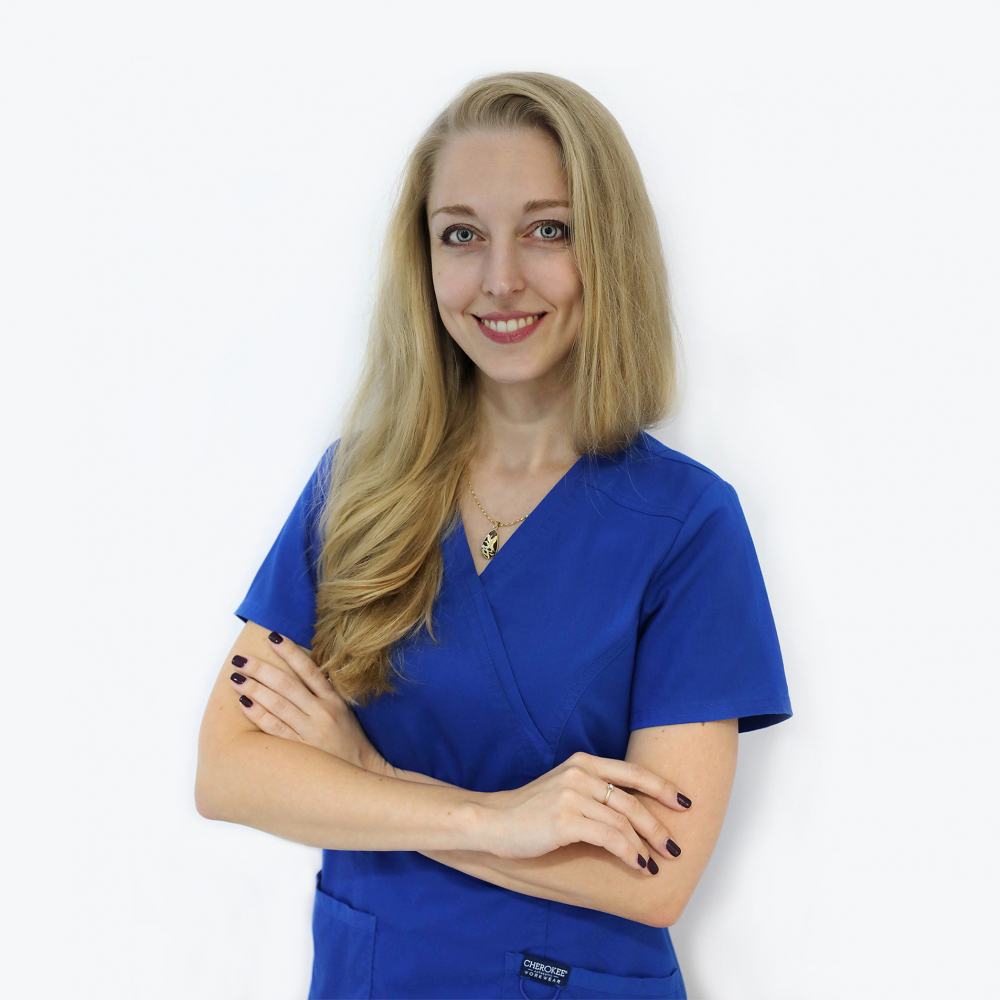
Orthodontist, PhD University of Barcelona
5 years in practice
Who we suit — and who we do not
Adults at any ageTeeth move at forty and at sixty — more slowly, but they move. The limit is set by the state of the gums, not by the passport
Teenagers still growingThe best time to tackle an overbite: we work with the teeth and with jaw growth at once
Anyone who started elsewhereBring your records and reports; we assess what has been done and either continue or revise the plan
Before restorative workWhere implants or crowns need to go into a corrected bite rather than an overloaded one
Four languagesSpanish, English, Russian, Ukrainian — the cephalometric findings explained in whichever is easiest for you
We will declineActive gum disease until it has been treated, an inability to attend regularly, and expectations that do not match what the method can deliver
Where to find us
The clinic is at c/ Entença, 69 in Esquerra de l'Eixample, two minutes from Rocafort station on metro line L1. Geography counts for more in overbite treatment than in one-off dentistry: adjustments fall every four to eight weeks across eighteen months to three years, and the journey adds up to dozens of trips.
| Address |
c/ Entença, 69 · 08015 Barcelona |
| Metro |
Rocafort and Urgell (L1), Tarragona (L3), Entença (L5) |
| Hours |
Mon–Thu 10:00–19:00, Fri 9:00–18:00 |
| Parking |
calle Entença, 61 |
| Where patients travel from |
Route |
| Neighbouring districts |
Sant Antoni, Poble-sec, Hostafrancs, Sants — about fifteen minutes on foot |
| L'Hospitalet, Santa Coloma |
L1 direct, out at Rocafort |
| Cornellà, Esplugues, Sant Joan Despí |
L5 to the station of the same name |
| Sant Boi, Martorell, Igualada |
FGC to Espanya, then one metro stop |
| El Prat, Castelldefels, Sitges |
Rodalies to Sants, change to L1 |
| Badalona, Terrassa, Sabadell |
Commuter train to Sants or Plaça Catalunya |
If you are planning two years of treatment, work out the journey first: missed adjustments extend a course more reliably than any clinical factor.
Why patients choose Corona Dental
Two orthodontistsDifficult Class II cases are discussed between two clinicians rather than decided alone, which measurably lowers the risk of a planning error in an overbite case.
Everything under one roofRadiographs, scanning and the appointment itself happen here — no separate trip to an imaging centre.
Late appointmentsMonday to Thursday we run until 19:00, so an adjustment can be fitted in after work.
Contact between visitsA debonded bracket, a wire rubbing, a cracked tray — message us on WhatsApp instead of waiting for the date.
Your files stay yoursScans and digital models are handed over on request, so a course can be continued in another country if you move.
In Barcelona since 2009Orthodontics runs for years, and it matters that the practice will still be here at the end of them.
Case examples
This section is in preparation.
Questions and answers
Can an overbite be corrected without braces?
The question is usually about visibility rather than mechanics, so it is worth separating the two. What decides the appliance is not how it looks but how much the teeth have to travel and in which direction: tipping a crown is one thing, moving a whole tooth bodily backwards is another, and only the second needs the control that fixed brackets give. Aligners handle the first comfortably. The honest answer therefore comes from the measurements, not from the catalogue.
Do myofunctional exercises help?
Between the ages of four and seven, exercises for the chewing and facial muscles genuinely influence how the bite forms and are used in their own right. Later they are only an adjunct to appliance treatment. In teenagers past twelve and in adults they achieve nothing on their own.
Will my profile change?
It depends on the type of overbite, and it is calculated beforehand. One point is rarely raised: the contour is set less by the teeth themselves than by the lips and the nasolabial angle that follow them — so the same amount of movement produces different visible change in different faces. The result is judged on profile photographs taken before and after, because the eye adapts to gradual change and stops registering it.
Am I too old for treatment?
No, and an overbite is treated routinely in adults. A tooth moves through bone at any age as long as the periodontal tissues are healthy. In adults remodelling is slower and courses run longer, and the ceiling is lower because growth has finished — but treatment is entirely possible at forty and at fifty.
Will teeth have to be extracted?
Not necessarily, and in an overbite it is decided on the measurements. The usual fear — being left with gaps in the arch — is unfounded: extractions are symmetrical, most often the fourth teeth on both sides, and the spaces close completely as the neighbouring teeth move across. In the finished smile the site of an extraction is not apparent.
How long is a retainer worn?
Longer than most people expect, and the period is set case by case: whether a skeletal discrepancy was compensated changes it substantially, and your orthodontist will give you the figure at debond. One thing people rarely ask about in advance: a bonded retainer makes cleaning the lower incisors harder — a water flosser or superfloss is needed, or calculus builds up on the inner surface within a couple of years. If a retainer debonds, do not wait for the next scheduled visit; come in within a few days, before the teeth have moved.
What happens if I stop treatment halfway?
Teeth taken out of their original position but not carried into the new one drift back, and not necessarily to where they started. The result can end up worse than the starting point. If circumstances change, tell your orthodontist: the appliance is removed in a planned way and what has been achieved is held, rather than abandoned mid-course.
Book an orthodontic appointment
Message us on WhatsApp and we will tell you which records your case needs and what they cost, before you come in.
Message us on WhatsApp c/ Entença, 69 · Barcelona · Mon–Thu 10:00–19:00, Fri 9:00–18:00
This page is for information and does not replace an examination. Diagnosis and treatment planning are carried out by a clinician after an appointment and a cephalometric analysis. Prices are valid for 2026. Registro sanitario E08706004.